In 2026, SEO is no longer just about “ranking #1” on a list of blue links. With the full integration of AI Overviews (formerly SGE) and Generative Engine Optimization (GEO), search has become a conversation. For small businesses, this is actually a massive opportunity to outshine big corporations by being more authentic and agile.
Here are 9 actionable in-house SEO tips to future-proof your business this year.
1. Master the “New” Google Search Console (GSC)
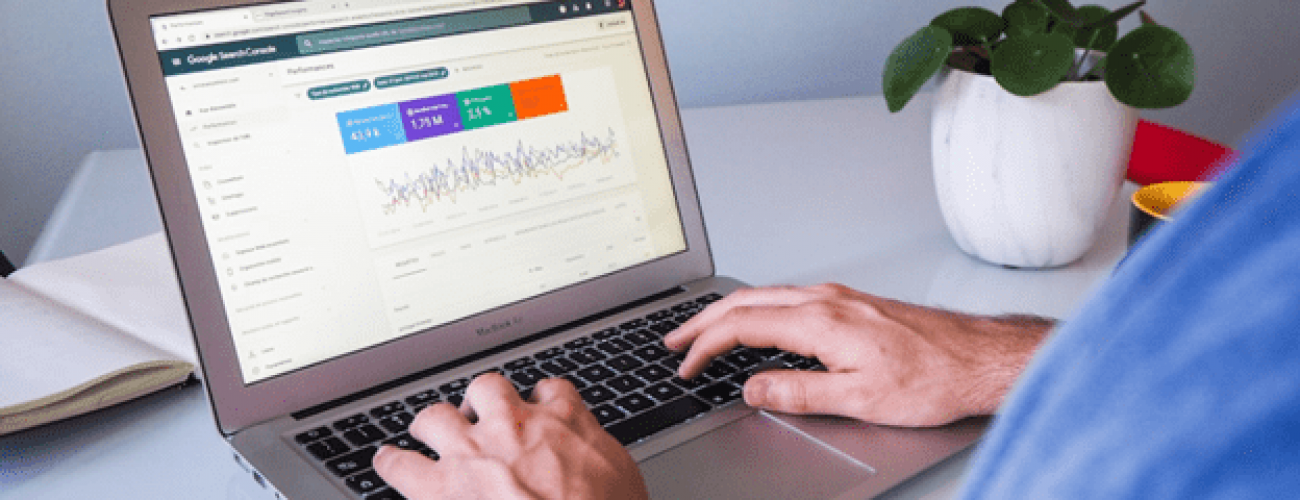
Google Search Console remains your most important free tool, but in 2026, the focus has shifted toward the Insights Tab and Contextual Reporting.
- Setup: If you haven’t already, verify your site via Google Search Console.
- The 2026 Strategy: Use the new Branded vs. Non-Branded filter. This helps you see if people are finding you because they already know your name (Brand) or because you’re answering their problems (Discovery).
- Annotations: Use the Custom Chart Annotations feature to mark exactly when you updated a content cluster or fixed a technical bug. This proves what actually worked.
2. Shift to “Answer-First” Keyword Research
Keywords in 2026 aren’t just strings of words; they are micro-intents. People now ask their AI assistants complex questions like, “Where can I find a sustainable florist in Brooklyn that does same-day delivery?”
- Tools: Use Google Keyword Planner for data, but use ChatGPT or AnswerThePublic to find the conversational “long-tail” questions your customers are actually asking.
- Tip: Optimize for conversational phrases. Don’t just target “SEO tips”; target “How do I set up an in-house SEO team on a budget?”
3. Target “Position Zero” with GEO (Generative Engine Optimization)
AI Overviews now summarize the web for users. To be the source that the AI cites, you need to use Answer-First formatting.
- The “TL;DR” Rule: Place a clear, 2-3 sentence direct answer to the main question at the very top of your pages.
- Structured Data: Use Schema.org markup (specifically FAQPage and LocalBusiness) to help AI engines “read” your site’s data instantly.
4. Double Down on E-E-A-T (Focus on “Experience”)
Google’s algorithm now prioritizes Experience, Expertise, Authoritativeness, and Trustworthiness. In 2026, the “Experience” part is king. AI can write facts, but it can’t share a personal story.
- Humanize Your Content: Include “I” and “We.” Share case studies, behind-the-scenes photos, and specific results you’ve achieved.
- Author Bios: Every blog post should have a clear author bio linked to a social profile, proving a real person wrote it.
5. Technical SEO: Optimize for “INP”
Forget just looking at “loading speed.” In 2026, the definitive metric is Interaction to Next Paint (INP). This measures how quickly your site reacts when a user clicks a button or menu.
- The Goal: Aim for an INP of 200 milliseconds or less.
- Test Your Site: Use PageSpeed Insights to check your Core Web Vitals. If your site feels “laggy” on mobile, your rankings will suffer.
6. Build Content Clusters, Not Random Posts
Search engines now reward Topical Authority. If you write one blog post about “In-house SEO,” it won’t rank. You need a “Cluster.”
- The Strategy: Create one “Pillar Page” (e.g., The Ultimate Guide to In-house SEO) and link it to 5-10 smaller, specific posts (e.g., “Hiring an SEO Manager,” “Best Free SEO Tools”).
- Internal Linking: This tells Google you are an expert on the entire topic, not just one keyword.
7. Hyperlocal SEO & Google Business Profile (GBP)
For small businesses, your Google Business Profile is often more important than your actual website especially with hyperlocal SEO.
- Weekly Updates: Treat your GBP like social media. Post photos, updates, and respond to every review within 24 hours.
- Neighborhood Keywords: Don’t just say you serve “New York.” Mention specific neighborhoods, landmarks, and local events to win “near me” voice searches.
8. Earn “Brand Mentions” Over Just Links
Traditional backlinks still matter, but brand mentions on reputable forums (like Reddit), podcasts, and social media are now massive signals for AI authority.
- Be Everywhere: Engage in community discussions. If people are talking about your brand on Reddit or Quora, AI engines like Perplexity and Gemini are more likely to recommend you.
- Monitor Mentions: Use free tools like Google Alerts to track where your brand is being discussed.
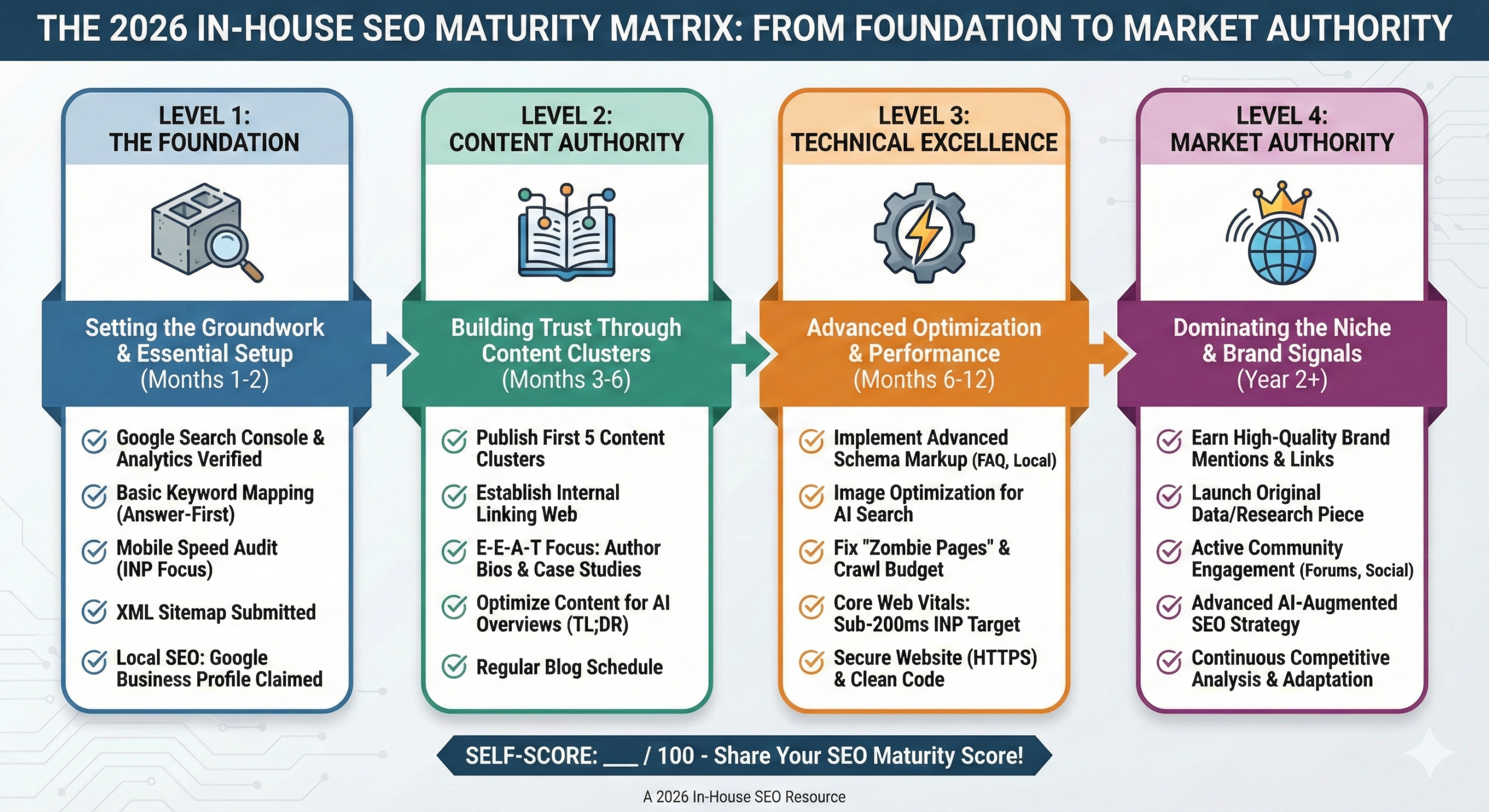
Love this roadmap? Share it on your site!
(Copy the code below to embed with a link back to the full guide)
9. Hiring the “AI-Augmented” SEO Professional
If you decide to hire in-house, don’t just look for a writer. Look for someone who knows how to use AI as a co-pilot.
- The Ideal Candidate: Someone who can use AI to scale content production but has the editorial skill to ensure every piece meets the E-E-A-T standards of 2026.
- Onboarding: Give them access to tools like Semrush or Ahrefs for deep data, but prioritize their ability to think strategically about user intent.
Conclusion
In-house SEO in 2026 is about authenticity. AI can generate a thousand pages of text, but it cannot replace the trust you build with your local community. By mastering the new Google Search Console and focusing on “answer-first” content, your small business can thrive in the age of AI search.